October 2026
Reading the Brawl Stars Roster
What 744 abilities on one four-axis map say about the game, and what a designer could build in the gaps
I plotted every ability in the game on one four-axis chart. Here is what the picture says about the roster, layer by layer, and what a designer could do with the gaps and the overlaps. The chart itself is live at /experiments/brawl-ability-map; this is the reading.
The method, briefly
The method is the one I sketched in 2012 during World of Battles: name the game’s fundamental verbs, make them axes, plot what you have, look at the gaps. The plot does not tell you what to build. It tells you where nothing has been built yet.
For Brawl Stars the verbs became four axes in two opposing pairs. Damage sits opposite Sustain (healing, shields, revives, raw health). Movement sits opposite Space (walls, zones, turrets, range, holding ground). Vision is a fifth quality that is not a direction, so it is drawn as a ring. Every ability gets a value from 0 to 10 on each axis. An ability with two unrelated effects, or effects on opposite axes, gets a second, hollow dot linked to the main one, so a Super that both damages and heals is recorded as two things.
The numbers are not opinions where numbers exist. Damage bands come from effective burst at Power 11, the level where everything is compared. Range is the game’s own tile count. Health is ranked across the roster. Where there is no number, which is most of movement and space, there are written rules: a short hop is 3 to 5, a long dash or teleport 7 to 9, breaking walls 6 to 8, a plain range increase is reach and not space. How a main attack or Super travels (in a line, over walls, onto a target, or with no projectile) is recorded separately, the same way as range.
A brawler, as opposed to an ability, is placed by peaks rather than averages. On each axis the brawler keeps the strongest thing it has there, body included, and the portrait sits as far out as its strongest axis, in the direction the whole profile pulls. Averaging had put the entire cast within four rings of the centre, which said nothing. Peaks say what each brawler is for.
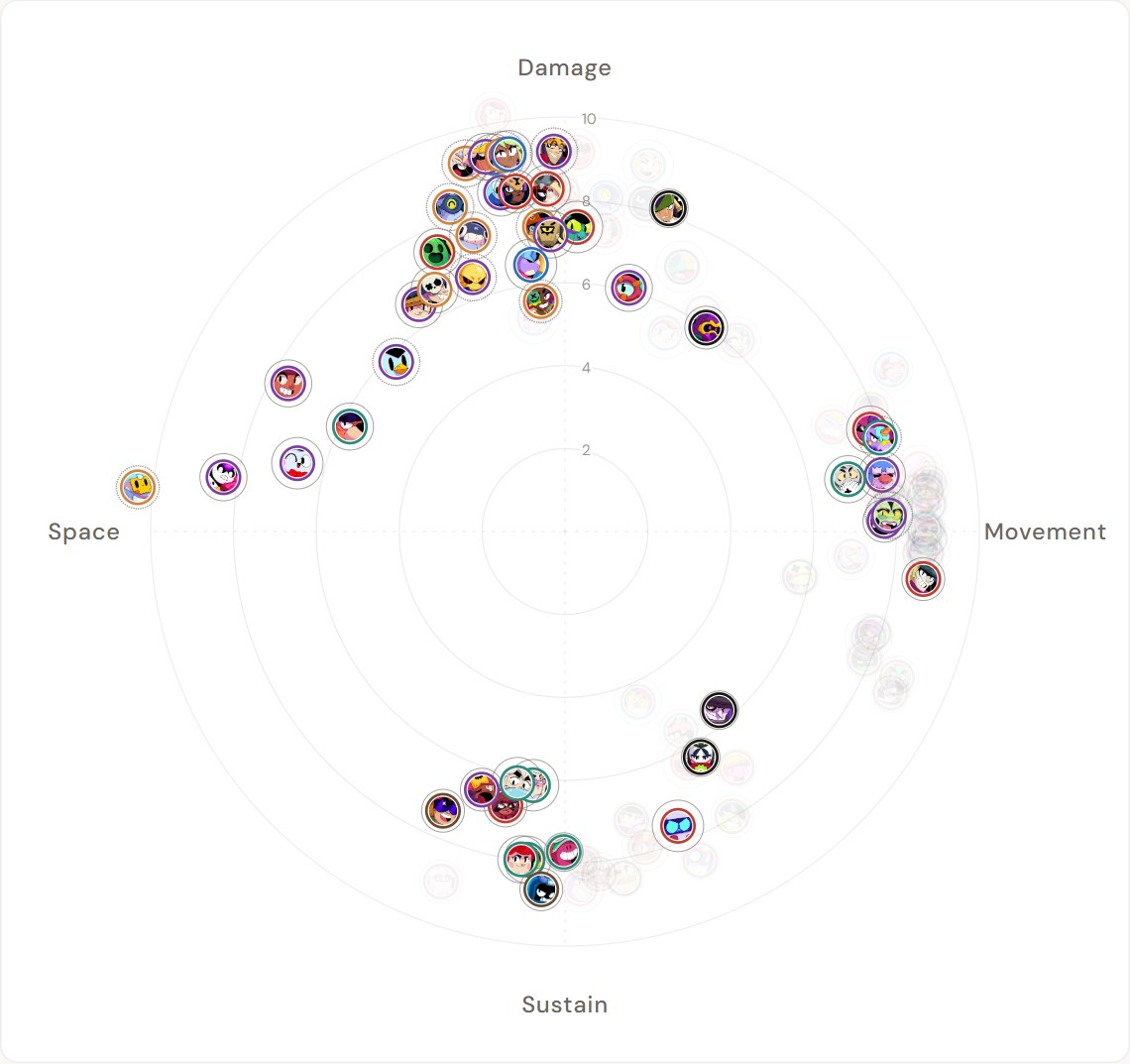
The roster picture
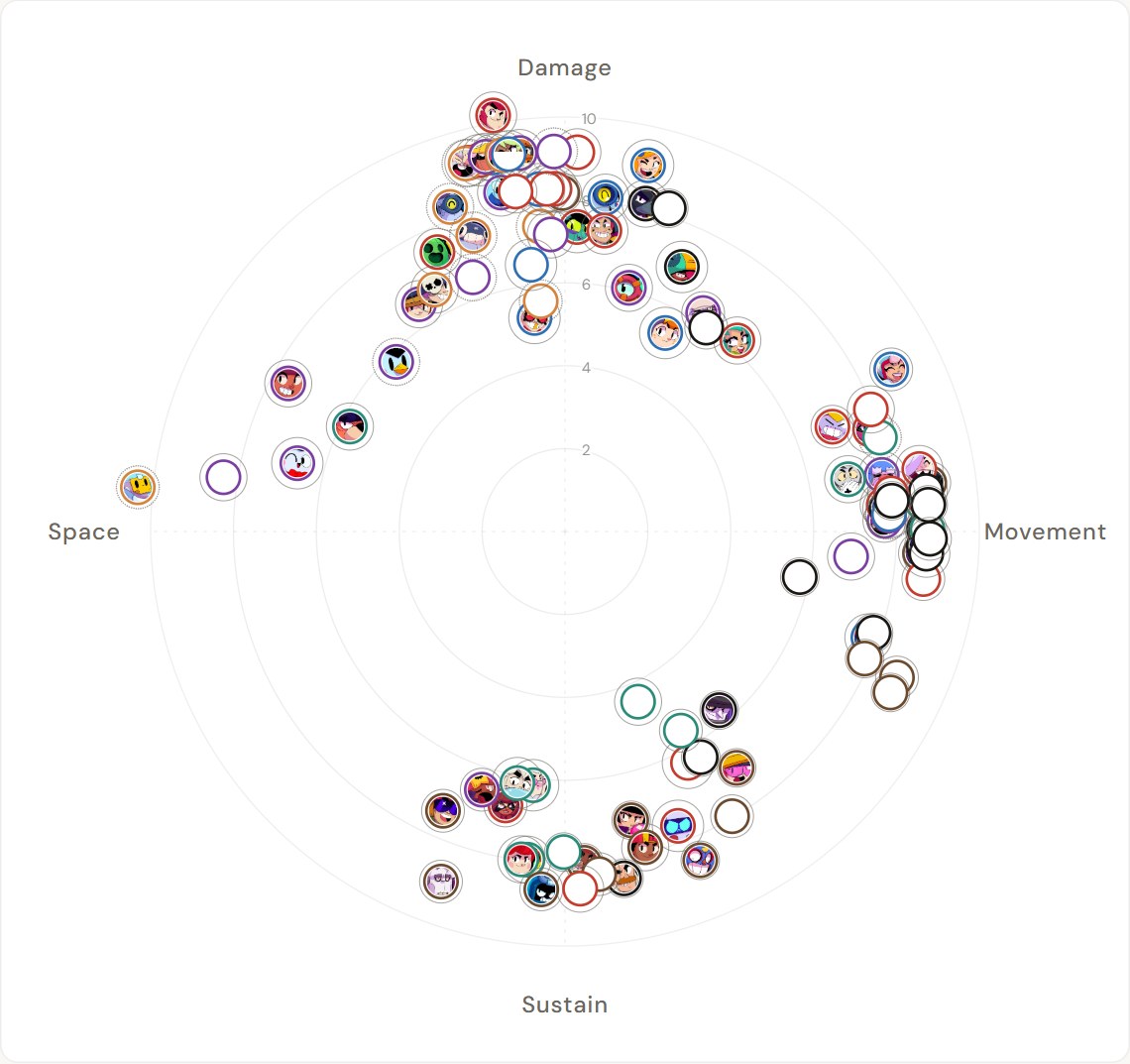
The roster has three populated directions and one that is nearly empty.
| Axis | Brawlers at 8 or higher | Brawlers at 10 |
|---|---|---|
| Movement | 32 | nobody |
| Damage | 25 | Colt |
| Sustain | 14 | nobody |
| Space | 2 | Sprout |
Movement is the most common strength in the game. Sixteen Supers sit at the outer ring, and they are dashes, jumps, rolls and charges. Assassins average Movement 7.5 as a class, and no other class averages as high on any axis. Brawl Stars is a game about shooting and repositioning, and the chart shows it.
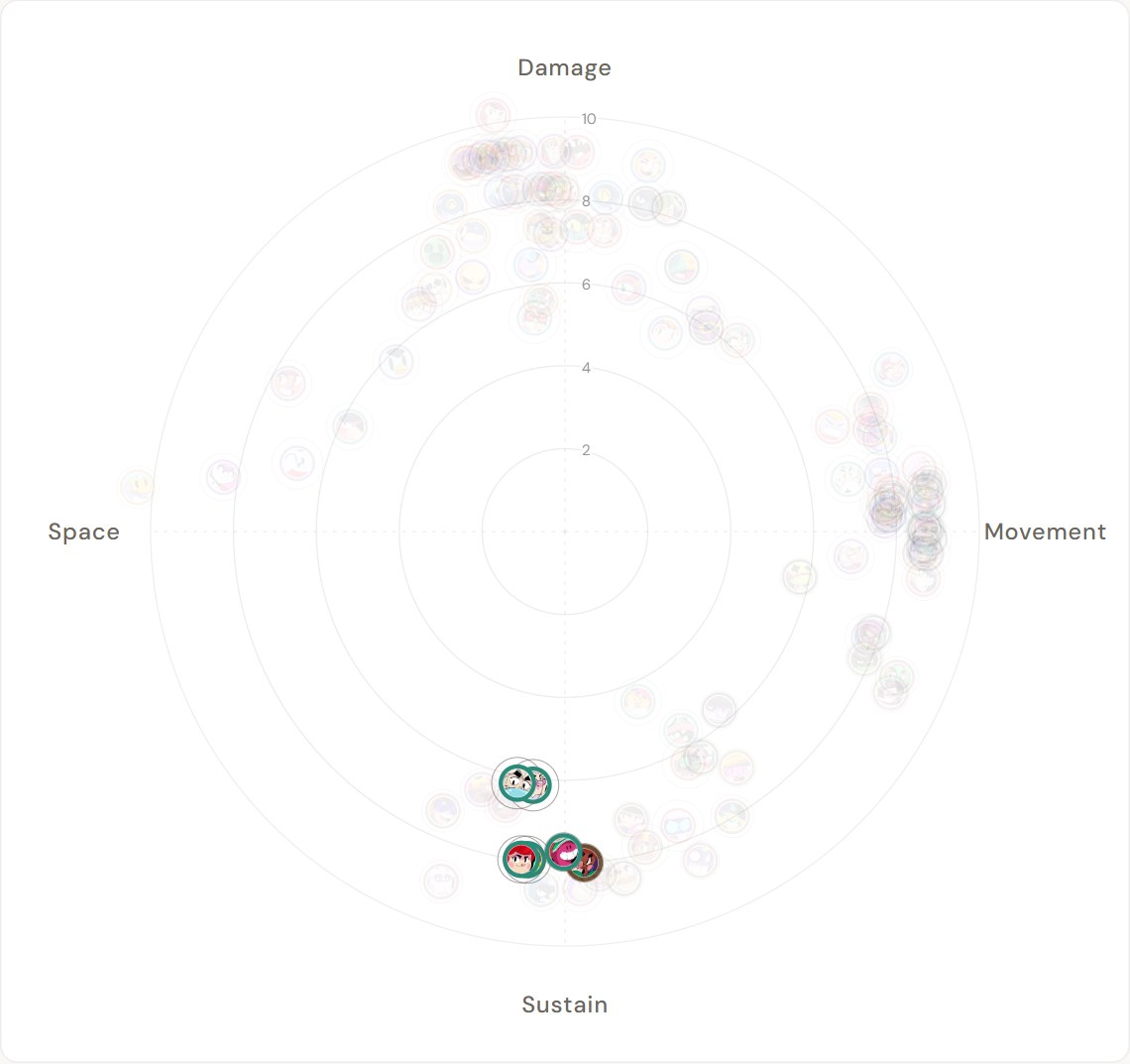
Sustain comes from health, not from kits. Of the fourteen brawlers at Sustain 8 or higher, most are there because of health alone. Healing or shielding from a kit at 7 or more exists on ten brawlers, and six of those are the recognised supports: Poco, Pam, Byron, Doug, Gus, Rosa. No Super in the game heals at 9 or 10. The strongest heal is an 8. Supports as a class average Sustain 5.4, barely above damage dealers at 5.0, and the damage dealers’ number is only their health. The game keeps healing weak on purpose to protect time to kill, which is a defensible choice, but the chart makes the cost visible: supports are the only class without a strong direction of their own.
Space is mostly a secondary effect. It is the most common secondary effect in the game and almost never the main one.
| Where Space appears | Count |
|---|---|
| Secondary dots on Space | 120 |
| Secondary dots on Sustain | 58 |
| Secondary dots on Movement | 45 |
| Main attacks with Space as the main axis | 1 |
| Supers at Space 9 or 10 | 1 |
Wall breaks, fire trails, slow zones and turrets are added to abilities whose point is damage. Artillery is the only class that treats Space as its main axis, and even there the class averages 5.9. The outer ring on the Space side is empty, and under this method it should hold anything that reaches the whole map. Brawl Stars has no such ability. Zeus’s ultimate in Dota 2 is the reference case: global, modest damage, present in every fight. There is no equivalent, and this is not a failure of the chart. It is a gap in the game.
The controller class has no direction of its own. Its average profile is the flattest of any class: Damage 6.4, Space 4.8, Movement 4.6, Sustain 4.5. What the game calls control is knockback, slows, stuns and zones, and this map records those as secondary dots on Movement and Space. Either the axis set is missing a dimension, or the finding stands: controller describes how a brawler is played, not the shape of its kit.
The first three brawlers are the most even. Shelly, Bull and El Primo are the only brawlers with 5 or more on all four axes. Brawlers released later are more specialised: most have one or two strong axes and two weak ones. Poco is the extreme case. His Sustain is 8 and no other axis of his reaches 4, so he is the only brawler built around a single axis.
Layer by layer
| Layer | Rows | Damage | Movement | Sustain | Space | At 9–10 |
|---|---|---|---|---|---|---|
| Main attacks | 105 | 91% | 7% | 1% | 1% | 0 |
| Supers | 105 | 44% | 41% | 7% | 9% | 22 |
| Hypercharges | 103 | 46% | 39% | 7% | 9% | 55 |
| Gadgets | 211 | 19% | 34% | 22% | 18% | 1 |
| Star powers | 211 | 39% | 19% | 29% | 5% | 0 |
Share of each layer’s main dots by the direction they point. Gadgets and star powers also include rows that touch no axis at all, about 7% of each, which is why those rows do not sum to 100.
Main attacks are almost all damage
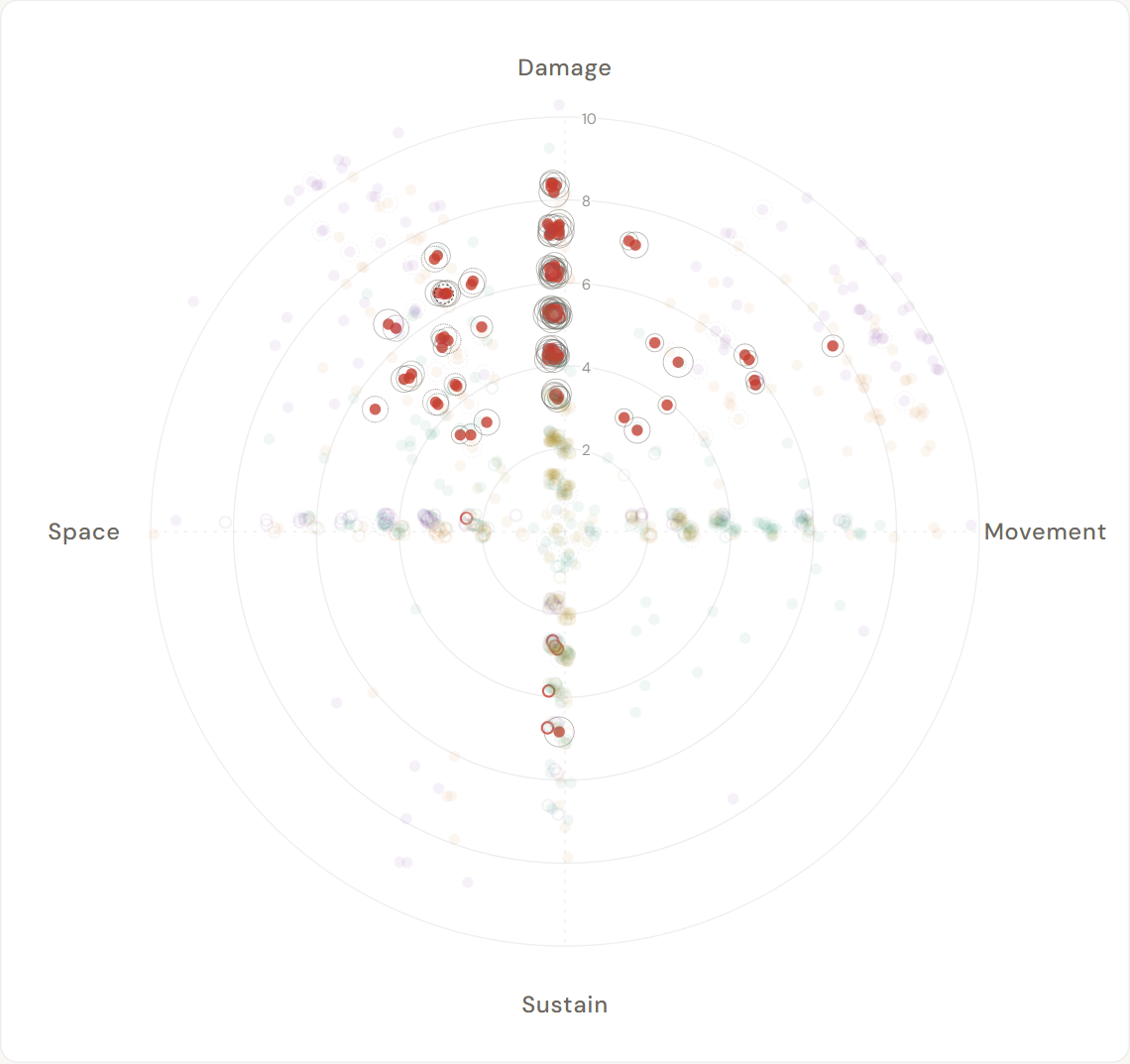
Ninety-one percent point at Damage, sixty-four percent are pure damage with nothing else, and not one reaches 9. The attack carries the damage-per-second allowance; everything else goes in the Super. Only Byron heals with his attack, only Mr. P builds with it. An attack that is a hook, a heal beam or a wall builder does not exist in the game.
Supers are where brawlers differ
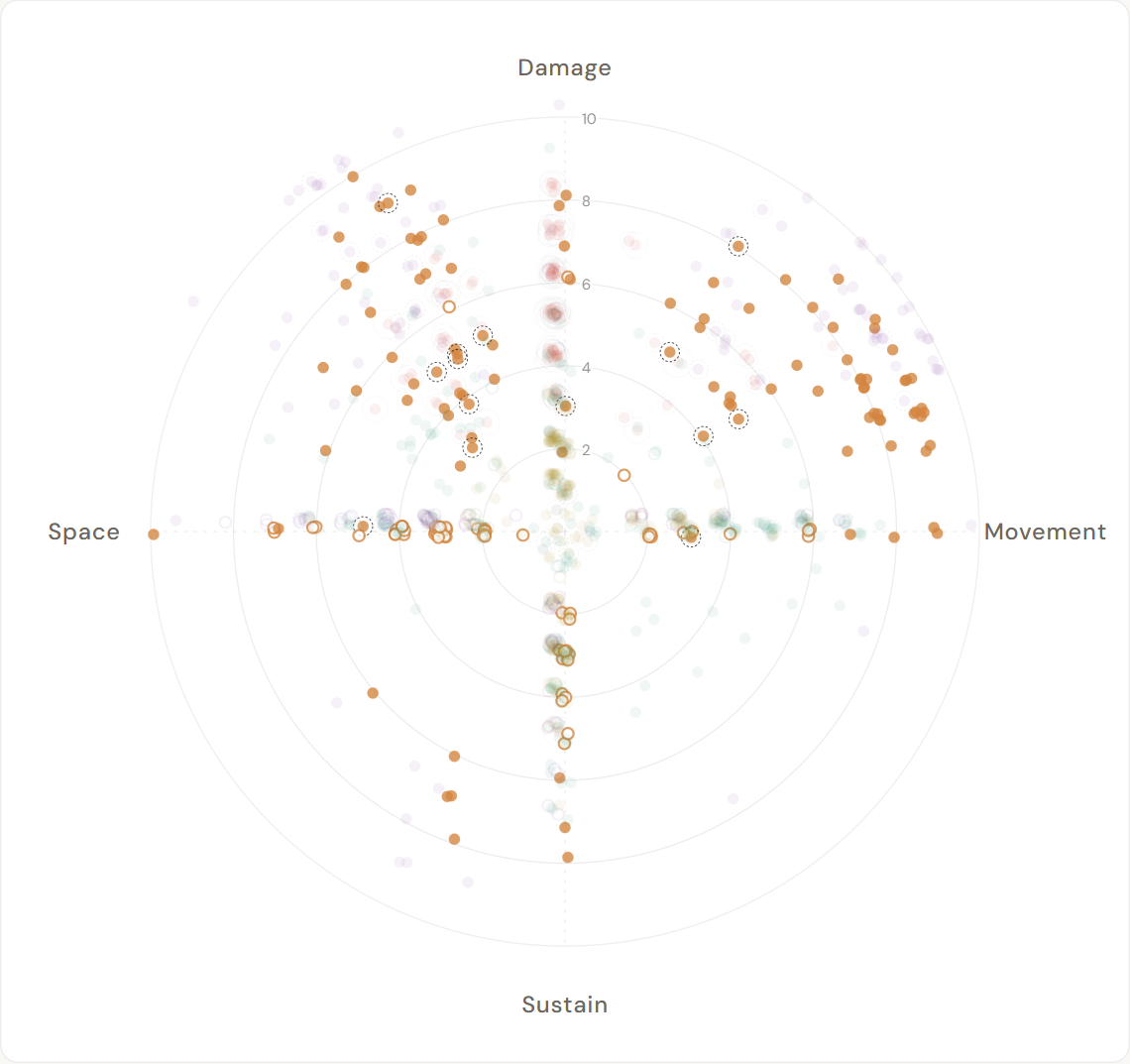
Half of all Supers carry a secondary dot, so a Super is nearly always damage plus a dash or a zone. Twenty-two sit at the outer ring, and sixteen of those are Movement. Sustain Supers are rare and small. Space Supers are rare and, apart from Sprout’s hedge, small.
Hypercharges carry most of the Space
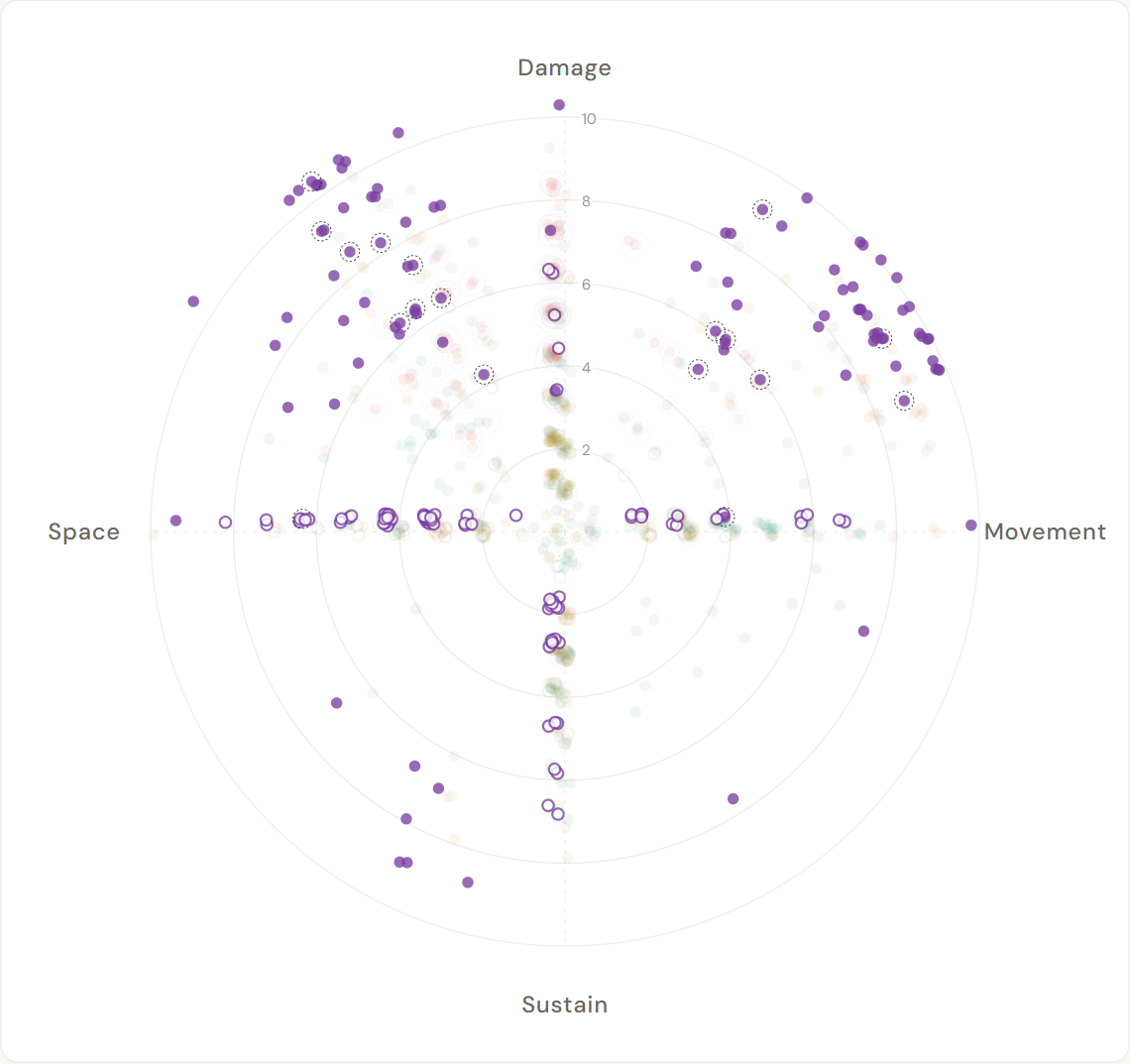
They are the only layer that reaches Space 8 to 10: Sprout, Meeple, Frank, Amber, Dynamike, Shelly. On this map a hypercharge is composed from its Super plus whatever it adds, so the independent signal is in the additions, and those are mostly fire trails, wider areas and ground zones. The designers are adding Space through hypercharges rather than through base kits.
Gadgets are the most evenly spread layer
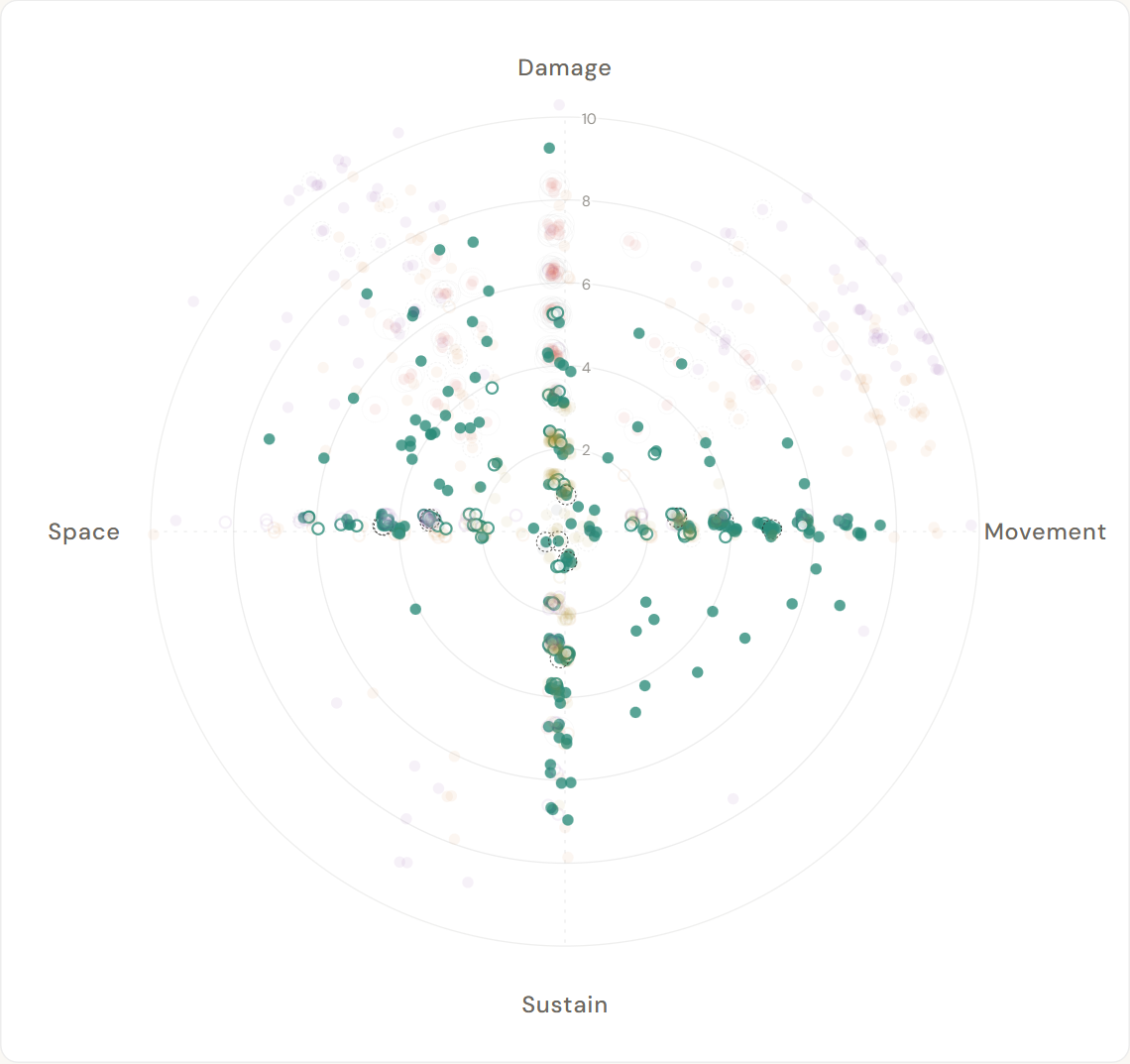
Movement 34 percent, Sustain 22, Damage 19, Space 18, almost all at radius 4 to 6. This is where a damage brawler gets a dash or a heal, and where a weakness in a base kit can be covered without a rework. Fifteen gadgets touch no axis at all.
Star powers are small single-axis changes
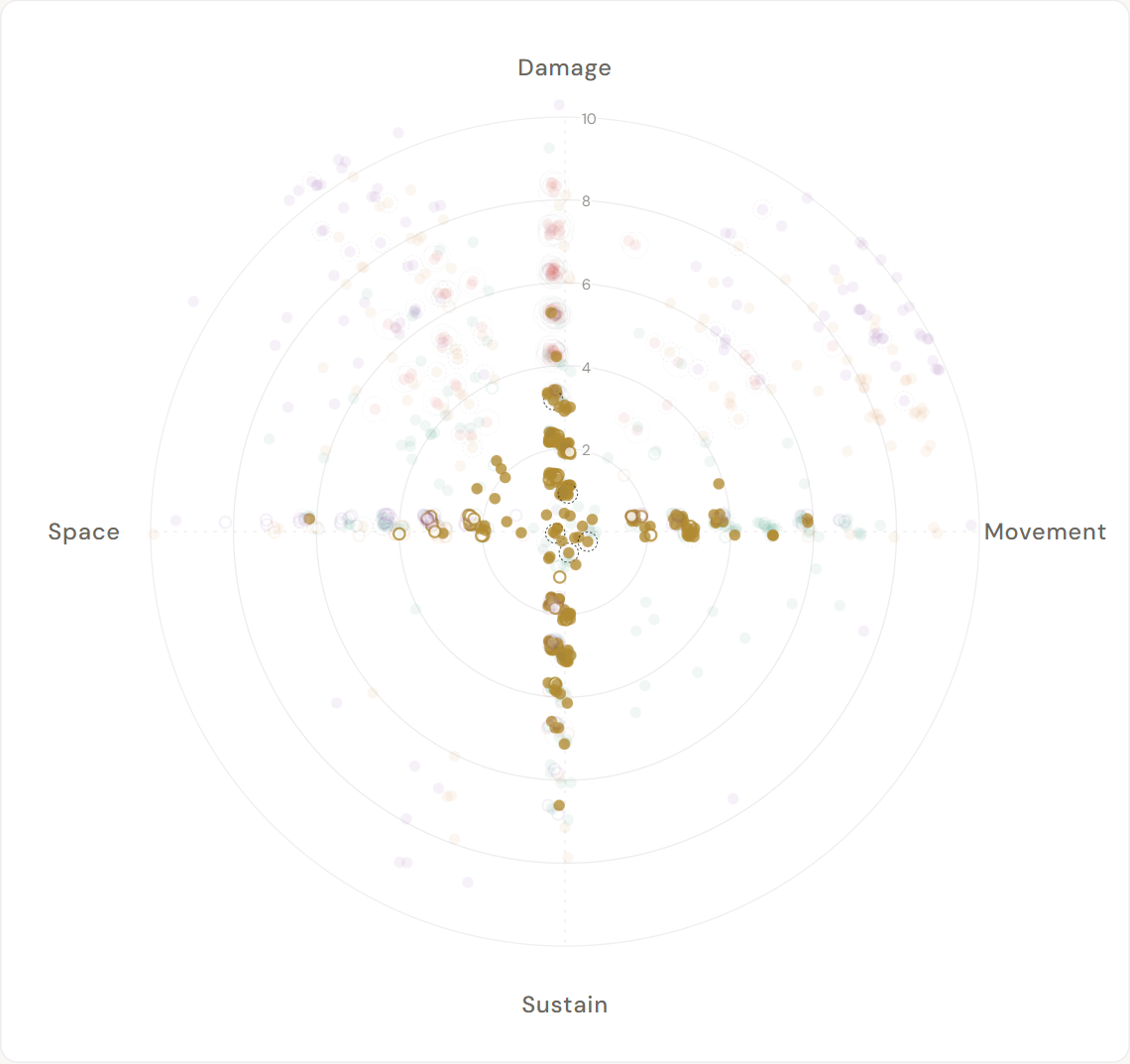
Sustain is 29 percent of them, which is the main way the game gives survivability to everyone: small passive bonuses rather than kit abilities. Sustain that lives in passives is never a decision the player makes during a match.
Vision belongs to six brawlers
Fifty-one abilities touch vision, but 8 or higher belongs to six brawlers: Leon, Sandy, Kaze, Alli, Kit, Lily. All six hide. Revealing and scouting barely exist, which means the counter to stealth is bushes and experience, not a kit.
How shots travel
The four axes say what an ability does. They do not say how it gets to its target, and in a game built on walls and bushes that decides a lot. A direct shot lands instantly but stops at every wall. A lobbed shot arcs over cover but is slow and easy to dodge. So every main attack and Super also carries a delivery tag. On the map it is a filter, a line in the tooltip, and a dotted reach ring on attacks that ignore walls.
| How it travels | Main attacks | Supers |
|---|---|---|
| Direct shot, stopped by walls and the first enemy | 52 | 10 |
| Pierces enemies, stopped by walls | 26 | 7 |
| Bounces off walls | 2 | 2 |
| Lobbed over walls | 11 | 30 |
| Lands on a target | 1 | 5 |
| Passes through walls | 0 | 10 |
| No projectile: melee, dash, jump, aura | 13 | 41 |
Walls stop almost every main attack. Twelve of 105 attacks ignore walls. Seven belong to artillery, four to controllers, one to a support. No tank, marksman, assassin or damage dealer has a main attack that reaches behind cover. Penny is the only artillery brawler whose attack is a direct shot.
Supers are where cover stops mattering. Forty-five Supers ignore walls. By class, every artillery brawler has a way to hit behind walls, as do 15 of 18 controllers and 8 of 12 supports. Only 2 of 16 tanks, 3 of 11 marksmen and 4 of 18 assassins do.
Tanks and assassins cross walls with their bodies, not their shots. Eleven of 16 tank Supers and 11 of 18 assassin Supers have no projectile: charges, jumps and dashes. For these classes a wall is something to move past, never something to shoot over.
Walls are almost never used as a tool. Four abilities in the game bounce off walls: Rico’s attack and Super, Ruffs’s attack and Bibi’s Super. In nearly every other kit a wall is only an obstacle.
Only nine brawlers ignore walls with both their attack and their Super: seven artillery brawlers, plus Mr. P and Ziggy.
The overlaps
Gaps are one half of what a map shows. The other half is crowding, and crowding is where tuning and reshaping work is waiting.
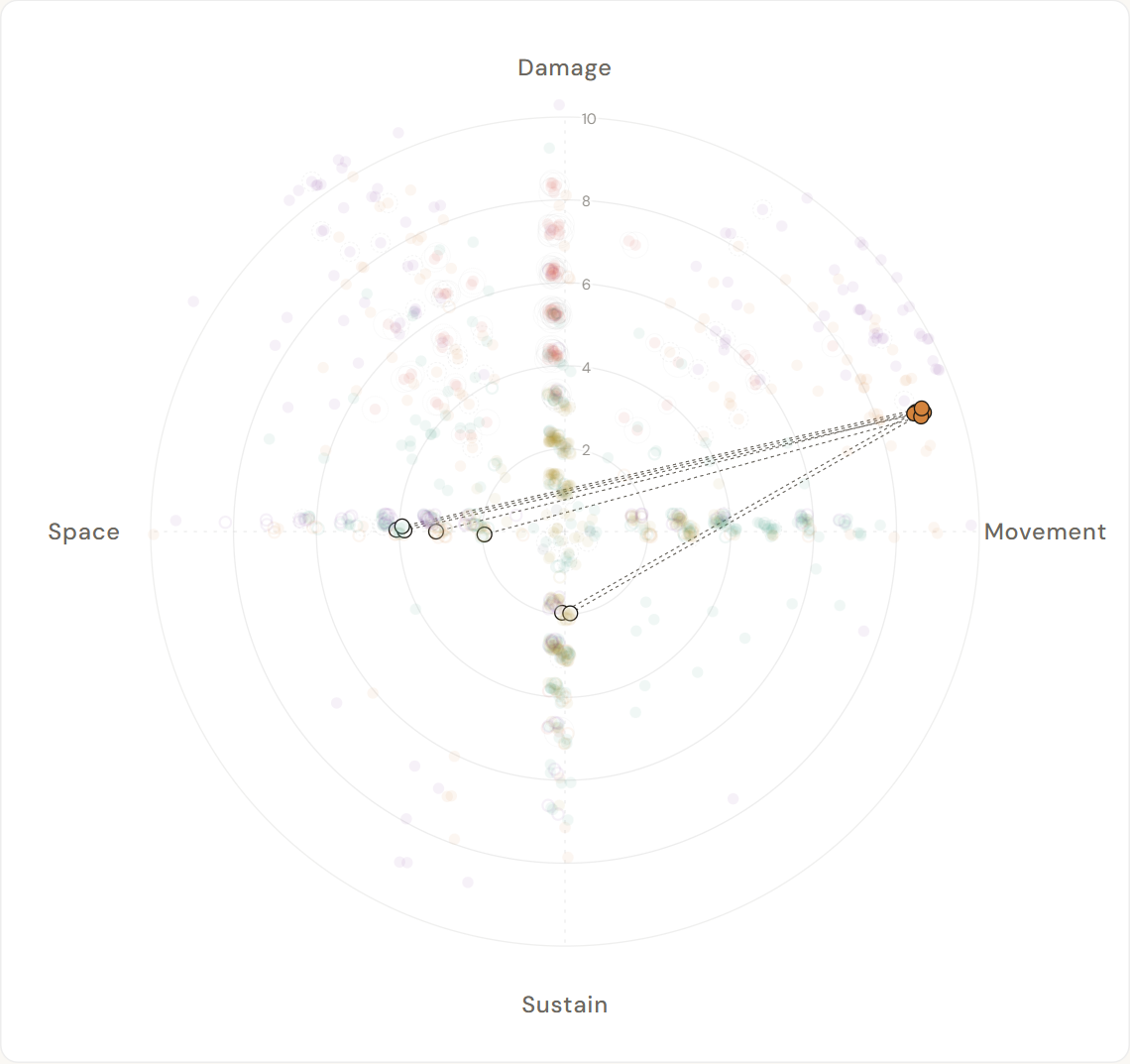
The dash template. Darryl, Buzz, Chuck, Ollie and Damian have Supers that are identical on this map. El Primo, Bonnie, Willow, Mina and Bolt form a second identical group. Tara, Gene, Gale, Stu and Trunk a third. Fifteen Supers, three shapes: move 8 or 9, hit for 3 or 4, nothing else. In play they differ by distance, by whether the brawler or the enemy moves, and by what happens on landing, and the map is blind to some of that. But five tanks and assassins with the same charge is a real signal: when a new brawler ships with a dash Super and light damage, it lands on a crowded spot.
Identical attacks. Fifty-six of the 105 main attacks are pure Damage between 4 and 7. Seventeen are exactly Damage 5 and nothing else. The game separates these by range, projectile count, spread and reload, which are tuning numbers rather than verbs. That is the cheapest place to add distinction, because a verb on an attack changes a brawler more than a number on it.
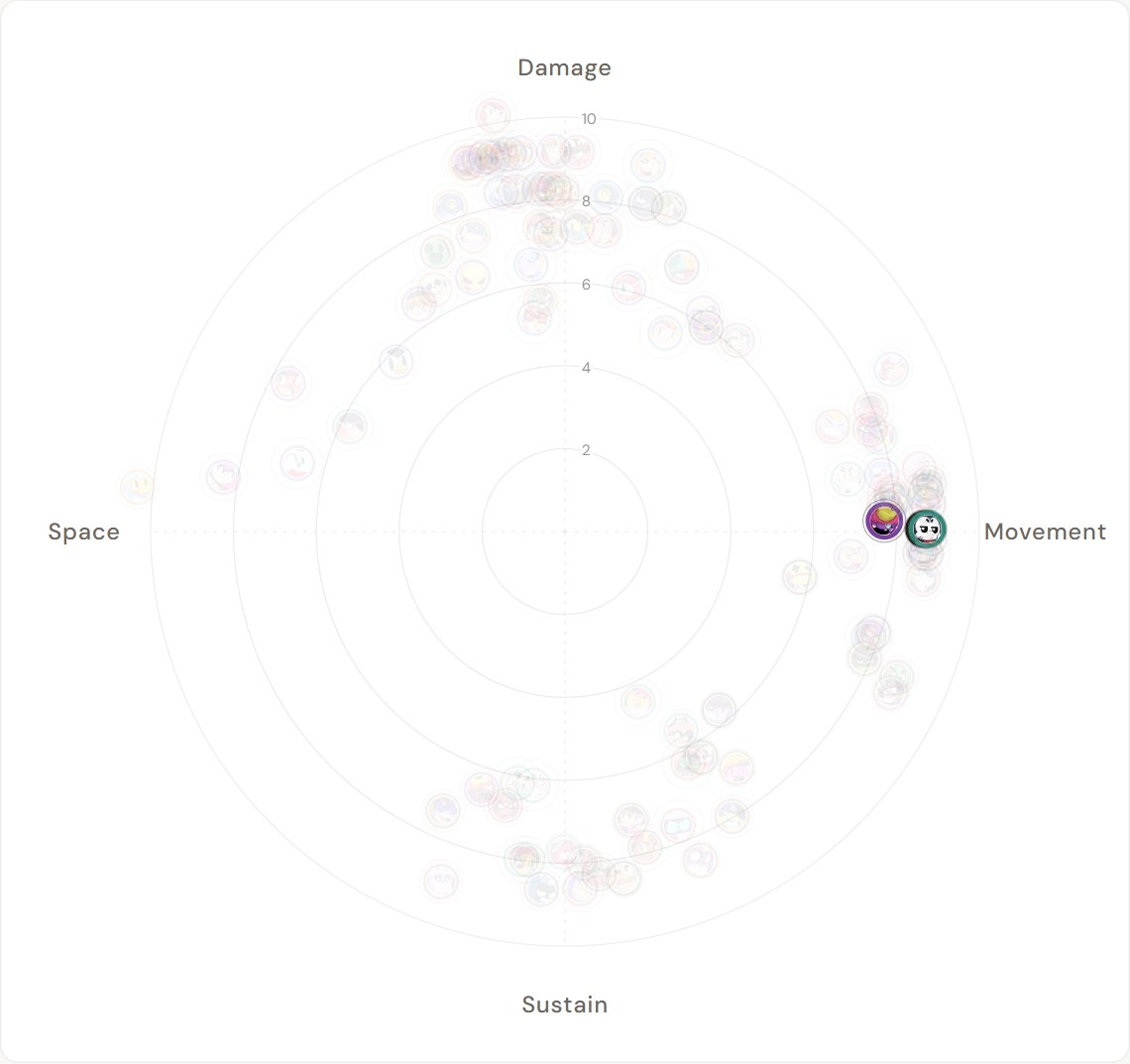
Twin pairs. By profile, Super shape and attack shape together, the closest pairs are Edgar and Kit, Mortis and Kaze, Lumi and Najia, Melodie and Starr Nova, Brock and Dynamike, Spike and Jessie. Two of these pairs are telling. Edgar and Kit have the same shape despite one being an assassin and the other a support, because the map cannot tell a dash at an enemy from a jump onto an ally. Gene reads the same way, because a pull is movement too. This is the one place I think the method itself needs a change: Movement should split into moving yourself and moving someone else. Control would then appear as its own direction, and the controller class would stop looking flat.
What a designer could do with this
These are sketches, not pitches. Each starts from an empty region or a crowded one, and says what a kit standing there might look like.
Gap: the Space outer ring. A map-wide ability
A Super that marks any point on the map and strikes it after a delay, with the marker visible to everyone. Or a Super that changes terrain across the whole map for a few seconds: every bush grows, every wall thickens. The damage can be modest. The reach is the point, and it would be the first ability in the game that affects the whole map at once. Counterplay is the visible delay.
Gap: Sustain 9 to 10. A sustain-first tank, and a Super that revives
No Super in the game heals at 9 and nothing revives. A tank whose Super is a shield wall, a damage conversion that turns what they absorb into a team shield, or a revive on a long charge would stand alone at the bottom of the map. The time-to-kill objection is real, and the answer is the same one the game already uses for stealth: make it rare, make it slow, make it visible.
Gap: attacks that are not damage. Inverted kits
Byron and Mr. P are the two precedents: an attack whose point is healing or building, with the damage moved to the Super. A builder whose attack lays blocks, a brawler whose attack is a hook, a medic whose attack is a beam. Two of 105 is not a direction yet. Three or four more would make the main attack a layer with variety instead of a single number.
Gap: vision beyond stealth. A scout
Six brawlers hide and nobody looks. A Super that reveals every enemy for a few seconds, an attack that marks a target through bushes, a gadget that plants a ward. This is the counter that stealth has never had, and it would make Vision a role rather than a perk.
Gap: moving others at scale. Mass control
Gene pulls one enemy. Nobody pulls three. A vortex, a wall that walks and pushes, a Super that swaps positions. If Movement is split into self and other, this region is visibly empty, and it is where a controller class would sit if the class had a shape.
Gap: walls as a tool. Bounce and ricochet kits
Four abilities bounce off walls. A brawler whose attack grows stronger with each bounce, or whose Super ricochets around a corner to reach someone hiding, would make maps with many walls favour a different brawler than open maps. That is a lever for map design as much as for brawler design.
Gap: a tank that fights over cover
No tank has an attack that ignores walls, and almost no tank Super is a projectile. A short-range lobbed attack on a high-health body would hit enemies hiding behind the wall the tank is pushing toward. It would break a defended position in a different way from charging through it.
Overlap: the dash template. Give each charge a second effect
Fifteen dash Supers, three shapes. The reshaping work is to give each one a consequence on landing that the others lack: one leaves a trail, one shields on arrival, one drags the nearest enemy along, one breaks the wall it hits. Several already do, and those are the ones that feel distinct in play. The ones that do not are candidates for a rework, and a rework here is cheap because the dash itself stays.
Overlap: identical attacks. A rule for new brawlers
Every new main attack carries one effect besides damage. A slow, a bounce, a lob, a pull, a heal on allies hit. The attack layer is where fifty-six brawlers are indistinguishable by shape, and it is where a single design rule would do the most for variety per unit of work.
Overlap: supports without a direction. Let supports reach the ring
If the strongest heal in the game is an 8 and most sustain lives in passives, supports will always read as weaker versions of other classes. Raising one or two support Supers to Sustain 9 would give the class a direction without touching time to kill across the board. The alternative is to accept that Brawl Stars has no support class, only damage dealers with a healing gadget.
Limits of the reading
- Hypercharge radii are inflated by construction. Every hypercharge is its Super plus one step, so 55 of them at the outer ring says more about the rule than about the game.
- Body health dominates brawlers with modest kits. The Sustain count is generous at brawler level and small at kit level, and both readings are in this article.
- Movement does not yet split self from other. Dashes, pulls and jumps onto allies share a direction. This is the next refinement, and it would change the controller reading.
- Range and delivery are drawn as rings, not as position. Two brawlers with identical shapes can play completely differently at different ranges, or when one shoots over walls and the other does not. The map shows this with ring size, a dotted ring and the filters, not with placement.
- Delivery is one tag per ability. Mixed kits are simplified: Chester’s random Super is tagged as no projectile, Sirius’s two-projectile attack as lobbed, Mina’s three-part combo as a direct shot.
- Placement is by hand. Every one of the 744 rows was placed under written rules and most have been reviewed, but a map like this is a conversation, not a measurement. Disagree with a dot and the dot moves.
Data reflects the roster in October 2026. The live map, with every ability, every secondary dot and the brawler view, is at /experiments/brawl-ability-map.