January 2012
The Macaroni Method
A coordinate framework for designing game abilities
A method I keep coming back to when designing game mechanics. I borrowed it from screenwriters, though I’ve long since forgotten the original technique — just the shape of the idea, which has stayed useful.
The setup
I’ll explain it through the actual problem that prompted it, during World of Battles: Morning Star development.
World of Battles was a free-to-play real-time strategy in a fantasy setting. Each player took up to 16 units into battle. A unit was a squad of 6–12 soldiers; you controlled the squad, not the individuals. No base-building — only fighting.
Units came in two flavours: base units and master units.
There were four unit types — archers, swordsmen, pikemen, cavalry — wired into a counter triangle: swordsmen beat pikemen, pikemen beat cavalry, cavalry beat swordsmen. Archers sit outside the triangle: they die fast in melee but have ranged attacks.
A master unit was a base unit with one extra magical ability — throw a fireball, buff allies, that sort of thing. Abilities could be active or passive.
The problem
During beta the master units had clear issues. Some weren’t interesting enough. Some were too complicated to use. Some felt redundant against each other. We decided to revise the whole roster — fix or cut what didn’t work, add new ones to fill the gaps.
I started the way most designers start: studying other games, hunting for interesting abilities, analysing our existing roster, trying to assemble something coherent. The trouble with that approach is it’s directionless. You find ten interesting abilities and have no good way to evaluate which fit, which conflict, which we already have a version of.
So I tried something else.
Step 1 — a coordinate system for gameplay
I drew a four-axis coordinate system. Each axis represents a fundamental gameplay element — the load-bearing layer everything else sits on top of.
For World of Battles, the four axes were:
- Triangle — using the right unit type against the right counter. Swordsmen into pikemen, cavalry into swordsmen, etc. The core tactical layer.
- Damage — every unit deals damage; the amount depends on stats and matchup.
- Movement — all units traverse the battlefield, climb terrain, navigate obstacles.
- Visibility — fog of war, affected by elevation and collisions. Movement uncovers it; you can hide, ambush, scout.
On top of the axes I drew concentric rings. The rings encode how strongly an ability affects an axis — outer ring is strong influence, inner ring is weak. So an ability lives at a particular angle (which axis or blend it touches) and at a particular radius (how strong its effect is).
Worked example: teleportation. Clearly affects Movement. If clicking the button instantly relocates the unit, that’s maximum-strength influence — outer ring on the Movement axis. If teleportation also lets you appear in fogged-out terrain, it touches Visibility too, and you’d nudge it slightly off-axis to reflect that.
Step 2 — plot every existing master unit
I took every master ability already in the game and placed it on the system. Here’s the original distribution:
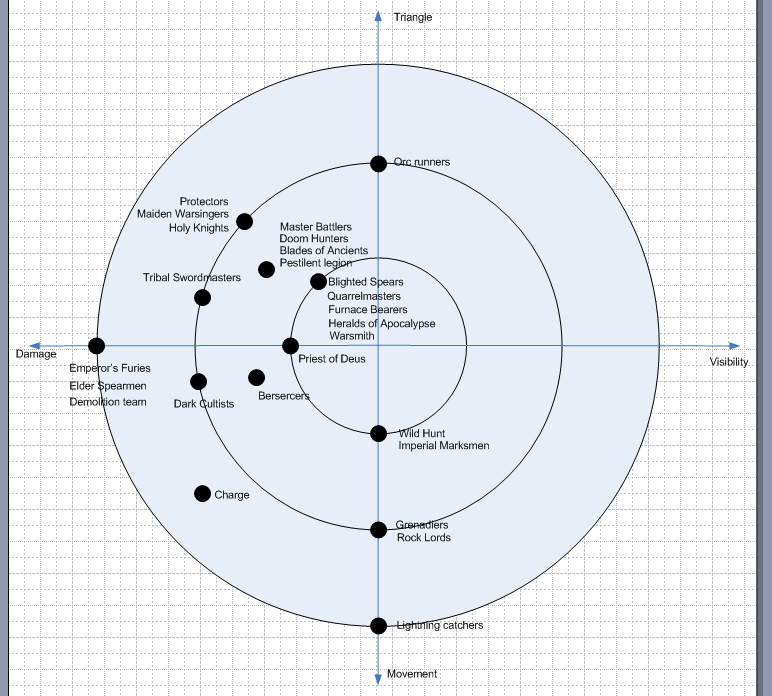
A few examples of how I placed specific units, since their names don’t tell you what they do:
- Demolition Team — threw a barrel that exploded on landing. Result is instant (when the target is in range) and the effect is pure damage. Outer ring on the Damage axis.
- Imperial Marksmen — archers with a passive slow; targets gradually lost speed when shot. Pure Movement effect, applied slowly. Inner ring on the Movement axis.
- Dark Cultists — when activated, the unit slowly bled health but gained near-doubled attack and a speed boost. Two effects: Damage and Movement. Not instant, but visible quickly (enemies start dying fast). Middle ring, between the Damage and Movement axes — closer to Damage since that’s the headline effect.
Step 3 — read the map
Once everything is plotted, two things become obvious almost immediately.
1. Heavy bias toward Damage. The cluster around that one axis is massively over-represented. This is bad for a strategy game — a game that mostly expresses itself through one mechanic is at minimum four times more boring than a game that uses all of them. Players run out of new things to do faster.
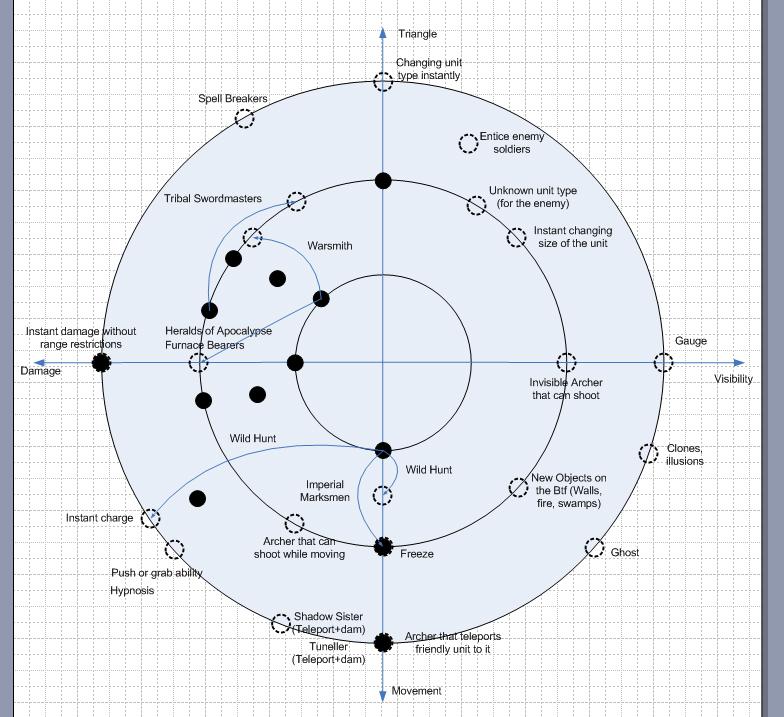
2. The empty space around the other axes is more than a balance problem. It’s a generator. Define what each axis means in one sentence — what does a “strong Visibility ability” look like? what does a “Triangle-bending ability” do? — and the muse starts dropping ideas, because the prompt is now specific instead of “design something cool”.
Here’s the redesigned roster after the analysis. Some are new; some are old units with reworked abilities for better balance and play-feel:
A note on the rings (instant vs gradual)
A word on why the radius dimension matters, beyond “strong vs weak”.
When a player uses an unfamiliar ability — especially a new player — instant feedback is critical:
- Instant effects show the player what the ability does.
- Instant abilities are easier to learn from.
- In strategy games, mid-fight chaos can make it hard to follow what’s happening; instant abilities give the player something they can react to.
In an ideal world, all abilities would be instant — especially Damage ones. But all-instant narrows the design space, and with it the strategic and tactical variety. So you make choices, and the rings let you see those choices laid out spatially instead of buried in spreadsheet rows.
Closing thought
I think this principle works for designing in basically any genre. I haven’t worked in all of them, so I’m not 100% sure — but the underlying move (define your fundamental gameplay axes, plot what you have, look at the gaps) seems portable.
That’s it. Concrete instructions are usually more useful than wordy philosophising about good and bad design — so if you have your own methods like this, share them too.
Originally written in Russian during World of Battles: Morning Star development around 2012. Translated and lightly edited for English readers in 2026.